Facebook
 X
X
 Pinterest
 Copy Link
Be the Expert Your Clients Deserve, Connect with Our Experts First!
Property Tax •
July 29, 2026
Florida Property-Tax Relief Proposal: Potential Benefits and Drawbacks for Homeowners

Property taxes are a significant part of homeownership costs, which is why Florida’s property-tax policy is receiving close attention in 2026. It is important to separate confirmed law from proposals: Florida property-tax changes remain subject to the legislative and voter-approval process, and homeowners should not make purchasing decisions based on expected savings alone.
One current proposal is described as increasing homestead-related tax relief while maintaining school-tax treatment separately. Reporting on the proposed 2026 ballot measure indicates that voter approval would be required before the change could take effect. Ballotpedia
Potential advantages include lower ongoing costs for eligible primary-residence owners, added financial predictability for homeowners on fixed incomes, and improved affordability when property taxes are included in a mortgage escrow payment. Relief for homesteaded properties could also be appealing to buyers considering a long-term move to Florida.
There are potential tradeoffs, too. Property taxes fund important local services, including public safety, infrastructure, parks, and other community needs. Lower collections could require local governments to reduce spending, identify new revenue sources, or make difficult budget decisions. The benefits may also vary by homeowner, property value, residency status, and the final form of any adopted measure.
For buyers, the takeaway is simple: evaluate the home based on today’s known costs. Review the current tax bill, homestead status, potential reassessment after purchase, insurance estimates, and association costs. Then treat possible policy changes as an issue to monitor—not as a guaranteed financial benefit.
Disclaimer: This post is informational only and does not provide tax, legal, or financial advice.
No Income Tax •
July 29, 2026
Why Florida’s No State Income Tax Matters for South Florida Relocators

Florida’s lack of a state personal income tax is often an important consideration for people relocating to South Florida. For employees, business owners, retirees, and remote professionals, this can be a meaningful part of an overall financial and lifestyle decision.
Without a Florida state income-tax return on earned income, some new residents may experience a different tax picture than they had in their former state. This can be particularly relevant for households moving from states with higher individual income-tax rates. It may also be a factor for retirees evaluating how different states treat retirement income.
But no state income tax does not mean no taxes—or automatically lower total costs. Buyers should also consider housing costs, homeowners insurance, property taxes, sales taxes, association fees, transportation, and healthcare. The financial value of a move depends on an individual household’s income, home price, spending patterns, and residency circumstances.
Establishing Florida residency can also require careful planning, particularly for people who maintain a home, business, or significant ties in another state. Documentation, domicile requirements, and tax treatment are personal matters that should be discussed with a qualified tax professional.
For many buyers, Florida’s tax environment is one part of a broader decision that also includes lifestyle, proximity to family, business opportunities, and real estate goals. South Florida’s combination of climate, amenities, connectivity, and housing options continues to make it a compelling relocation destination.
Considering a move to South Florida? Let BHGRE FL 1st Relocation Specialists help you understand the local housing options while your tax advisor helps you evaluate the financial details.
Disclaimer: This article is general information, not tax or legal advice. Consult a qualified tax professional regarding your individual circumstances.

Relocation •
July 29, 2026
Moving to South Florida: A Practical Relocation Guide for Homebuyers
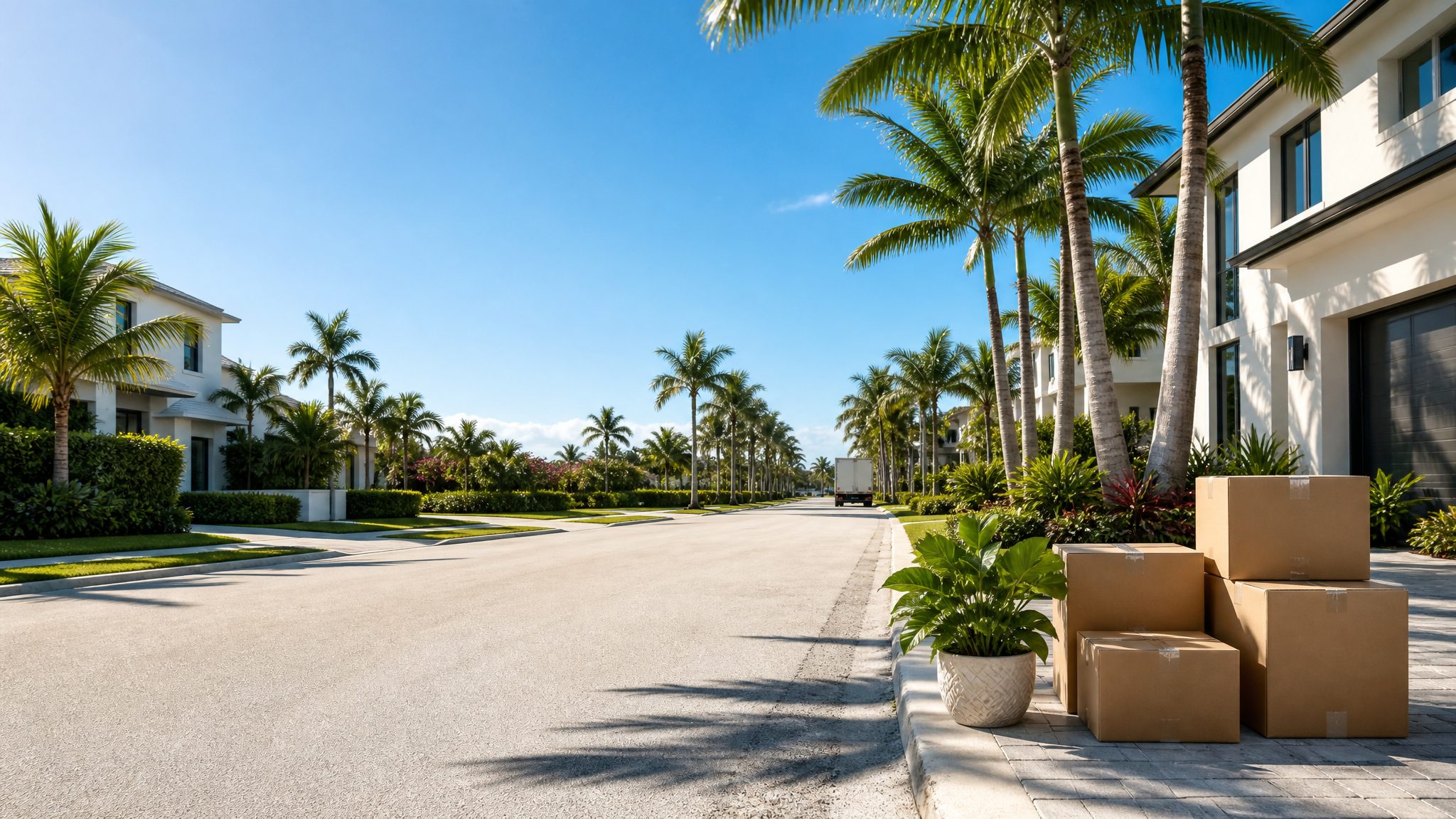
Moving to South Florida is about more than choosing a home—it is about finding the community and lifestyle that fit your next chapter. From Miami-Dade and Broward to Palm Beach County and beyond, each area offers a distinct mix of neighborhoods, housing styles, schools, commutes, amenities, and access to the coast.
Begin by defining your priorities. Do you want walkability, waterfront access, proximity to work, a quieter residential setting, access to airports, or a low-maintenance condominium lifestyle? Clarifying these needs early makes your search more focused and productive.
Next, build a realistic ownership budget. In addition to the purchase price, consider property taxes, homeowners insurance, flood-zone considerations, condominium or HOA fees, utilities, maintenance, and moving expenses. For condo buyers, request and review association documents, budgets, rules, reserve information, and any known assessments.
If you are relocating from another state, a visit can be helpful before making a final decision. Tour neighborhoods at different times of day, test commute routes, visit nearby shops and parks, and ask questions about the property’s day-to-day lifestyle. When an in-person trip is not practical, virtual tours and detailed video walkthroughs can help narrow the search.
South Florida’s appeal includes warm weather, extensive cultural and dining options, international connectivity, and a broad range of residential choices. However, the “right” area is personal. A home near the beach may be ideal for one buyer, while another may value land, privacy, or a short commute more highly.
Planning a Move? Our Relocation Specialists are here to assist: Relocation Services
Lending •
July 29, 2026
South Florida Home Lending: 6 Steps to Prepare for a Successful Purchase

Financing is one of the most important parts of a successful South Florida home purchase. A clear lending strategy helps buyers understand their price range, strengthen their offer, and avoid surprises after they find the right property.
Start with a full preapproval, not just a quick online estimate. A lender can review income, assets, credit, debts, and the loan program that may best fit your situation. This provides a more reliable purchasing range and shows sellers that you are prepared.
Next, consider the complete monthly cost of ownership. Your payment may include principal, interest, property taxes, homeowners insurance, mortgage insurance when applicable, and—in a condominium or planned community—association dues. South Florida buyers should be especially thoughtful about insurance and association costs before finalizing a budget.
It is also important to compare loan options. A fixed-rate mortgage may offer predictable payments, while an adjustable-rate mortgage may be worth discussing for buyers who expect to move, refinance, or sell within a shorter period. The best choice depends on your financial profile, time horizon, and comfort with risk.
Do not make major credit changes while purchasing a home. Avoid opening new accounts, financing large purchases, changing jobs without discussing it with your lender, or moving substantial funds without keeping documentation. These steps can affect the underwriting process.
Mortgage rates and loan terms change frequently, so buyers should obtain personalized, current quotes rather than relying on general headlines. Florida mortgage-rate reporting in July 2026 showed rates varying by lender, credit profile, loan type, and points.
Before you begin touring homes, connect with a qualified lender and the BHGRE Florida 1st team to build a purchase plan around YOUR goals!
Disclaimer: This article is educational only and is not lending or financial advice
South Florida Real Estate News •
July 29, 2026
South Florida Real Estate News

South Florida’s real estate market continues to evolve in 2026. After years of exceptionally rapid appreciation and intense competition, many areas are moving toward a more balanced environment. That does not mean every neighborhood or property type is performing the same way—but it does mean buyers and sellers should make decisions based on current, local data rather than yesterday’s headlines.
For buyers, increased inventory can create more choice and more room for careful negotiation. A well-priced property in a desirable location can still attract strong interest, but buyers may have greater opportunity to compare homes, request appropriate inspections, and negotiate terms that fit their needs.
For sellers, presentation and pricing remain essential. Homes that are updated, accurately priced, professionally marketed, and positioned for their target audience are more likely to stand out. Overpricing can lead to longer market times and later price adjustments, especially where buyers have more alternatives.
Condominiums deserve particular attention. Association budgets, reserve requirements, maintenance needs, insurance costs, and building-specific disclosures can all affect affordability and buyer demand. Single-family homes, luxury properties, waterfront homes, and investment properties each have their own market dynamics as well.
The best question is not simply, “Is it a buyer’s market or a seller’s market?” Instead, ask: What is happening with comparable homes in this neighborhood, in this price range, right now?
South Florida remains a major destination for lifestyle-driven buyers, entrepreneurs, retirees, and remote professionals. A recent Miami Realtors report valued the region’s housing market at approximately $1.6 trillion, illustrating the scale and long-term importance of local real estate.
Look for current pricing and inventory with us. Contact Our Team Here !
Uncategorized •
June 22, 2026
Motto Mortgage Weekly Economic Update | June 22, 2026
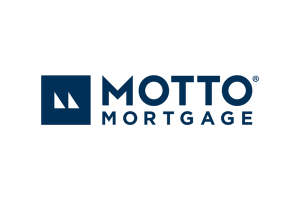
Weekly Economic & Mortgage Update: What It Means for Homebuyers and Sellers
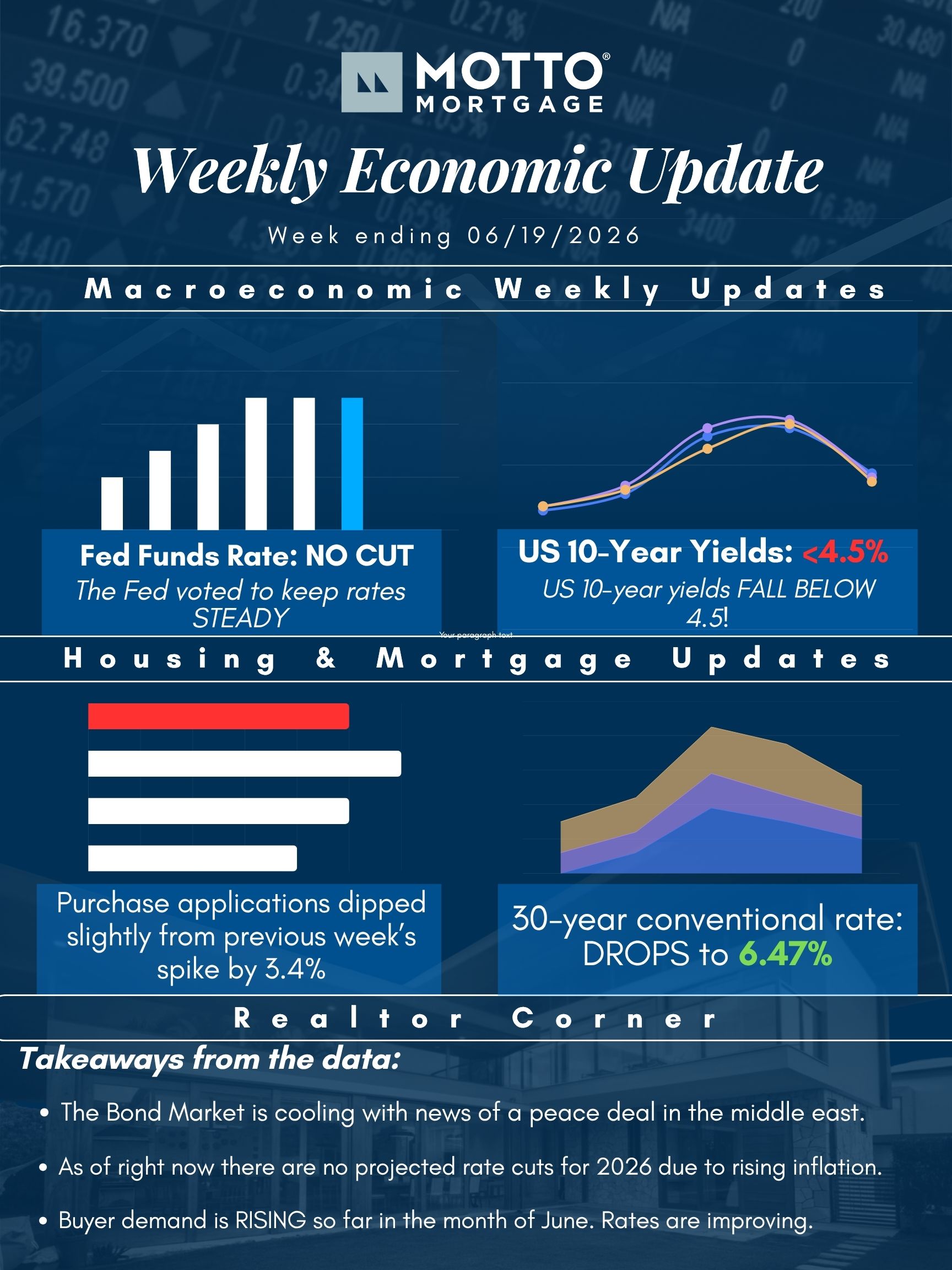
Federal Reserve Holds Rates Steady
The Federal Reserve voted to leave interest rates unchanged this month. While many consumers are still hoping for future rate cuts, the Fed continues to monitor inflation before making any adjustments.
What this means: Stability is generally a positive sign for the housing market, as it reduces uncertainty for buyers, sellers, and lenders.
Treasury Yields Continue to Decline
The U.S. 10-Year Treasury Yield has fallen below 4.5%, an important benchmark that often influences mortgage rates.
Why it matters: Lower Treasury yields can help push mortgage rates lower, improving affordability for prospective homebuyers.
Mortgage Rates Move Lower
Average 30-year conventional mortgage rates declined to approximately 6.47% this week.
The takeaway: Even modest decreases in mortgage rates can significantly improve purchasing power and monthly payment affordability for buyers.
Buyer Activity Remains Strong
Purchase mortgage applications dipped slightly (3.4%) following the previous week's surge, but overall buyer demand continues to show strength throughout June.
What we're seeing locally: Many buyers who have been waiting on the sidelines are beginning to re-enter the market as financing conditions improve.
Key Takeaways for Buyers and Sellers
- Mortgage rates are trending in the right direction.
- Buyer demand remains healthy despite market challenges.
- Lower bond yields are helping support improved lending conditions.
- While no Federal Reserve rate cuts are currently projected for 2026, the market continues to adjust favorably for homebuyers.
For anyone considering a move, the current market presents opportunities on both sides of the transaction. Buyers may benefit from improving financing conditions, while sellers continue to have access to an active pool of motivated purchasers.
Uncategorized •
June 1, 2026
Post #328
Connect With Motto Mortgage Today
Inflation Cools While Mortgage Rates Remain Elevated: What It Means for Homebuyers
This week's economic data offered encouraging signs for consumers, even as mortgage rates remained elevated.
The latest reports showed inflation continuing to moderate while economic growth came in below expectations. At the same time, mortgage rates edged slightly higher, creating a mixed but potentially promising outlook for the housing market.
Key Economic Highlights
This week's update included several important economic indicators:
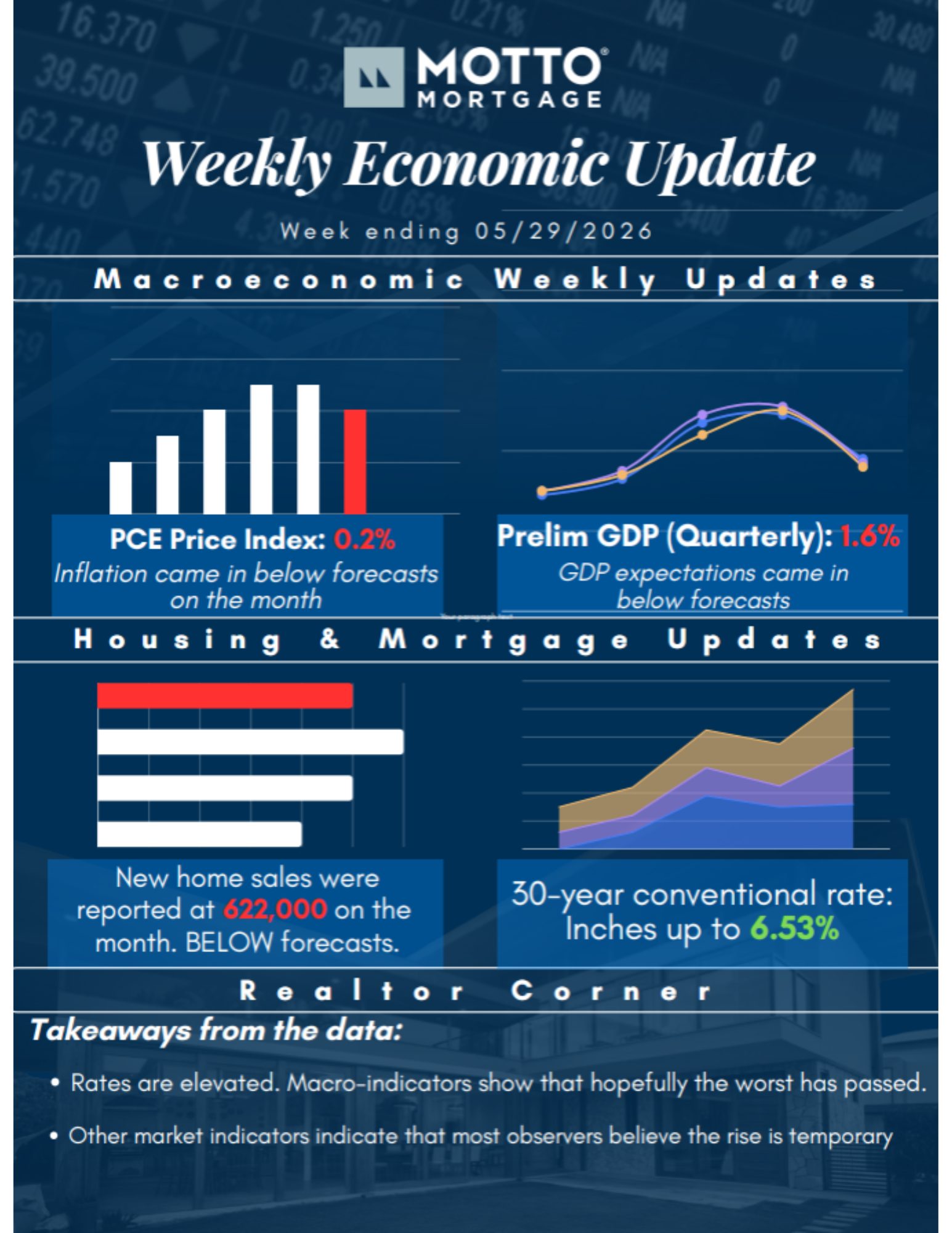
- Personal Consumption Expenditures (PCE) Price Index increased just 0.2%
- Preliminary Gross Domestic Product (GDP) growth came in at 1.6%
- New home sales were reported at 622,000, below forecasts
- The average 30-year conventional mortgage rate rose slightly to 6.53%
Taken together, these numbers suggest that inflation pressures may be easing while economic activity is slowing to a more sustainable pace.
Inflation Continues to Move in the Right Direction
The PCE Price Index, which is the Federal Reserve's preferred inflation gauge, increased by only 0.2% during the month.
For consumers and prospective homebuyers, lower inflation is generally positive news because it reduces pressure on the Federal Reserve to keep interest rates higher for longer.
While one month's data does not establish a trend, continued moderation in inflation could create a more favorable environment for mortgage rates later this year.
Economic Growth Slows But Remains Positive
The preliminary GDP reading of 1.6% came in below expectations.
Although slower growth may sound concerning, many economists view moderate economic growth as a healthy development after several years of elevated inflation and aggressive interest rate increases.
A cooling economy often helps bring inflation under control, which can ultimately benefit housing affordability.
Mortgage Rates Remain Near Recent Highs
The average 30-year conventional mortgage rate increased slightly to 6.53%.
While rates remain elevated compared to the historic lows seen in previous years, many buyers are beginning to adjust their expectations and move forward with their purchasing plans.
Real estate markets across South Florida continue to demonstrate resilience as buyers recognize that waiting for significantly lower rates may not be the best long-term strategy.
New Home Sales Reflect Market Adjustment
New home sales were reported at 622,000, falling below forecasts.
This decline may indicate that some buyers remain sensitive to affordability challenges created by higher mortgage rates. However, demand for housing remains strong in many desirable markets, particularly those experiencing continued population growth and relocation activity.
What This Means for South Florida Buyers and Sellers
At Better Homes and Gardens Real Estate Florida First, we continue to see buyers entering the market despite rate fluctuations.
Many consumers are focusing on long-term homeownership goals rather than trying to perfectly time interest rates.
For sellers, properly priced homes continue to attract attention from motivated buyers.
For buyers, today's market may present opportunities to negotiate terms and secure a home before competition increases if rates begin to decline.
Uncategorized •
May 26, 2026
Motto Mortgage
Mortgage Rates Hold Steady as Buyer Demand Continues to Rise
This week’s economic update from Motto Mortgage highlights an important shift in the housing market: buyers are continuing to move forward despite elevated mortgage rates.
While many consumers expected the market to slow significantly in 2026, recent data suggests the opposite may be happening.
Key Economic Highlights This Week
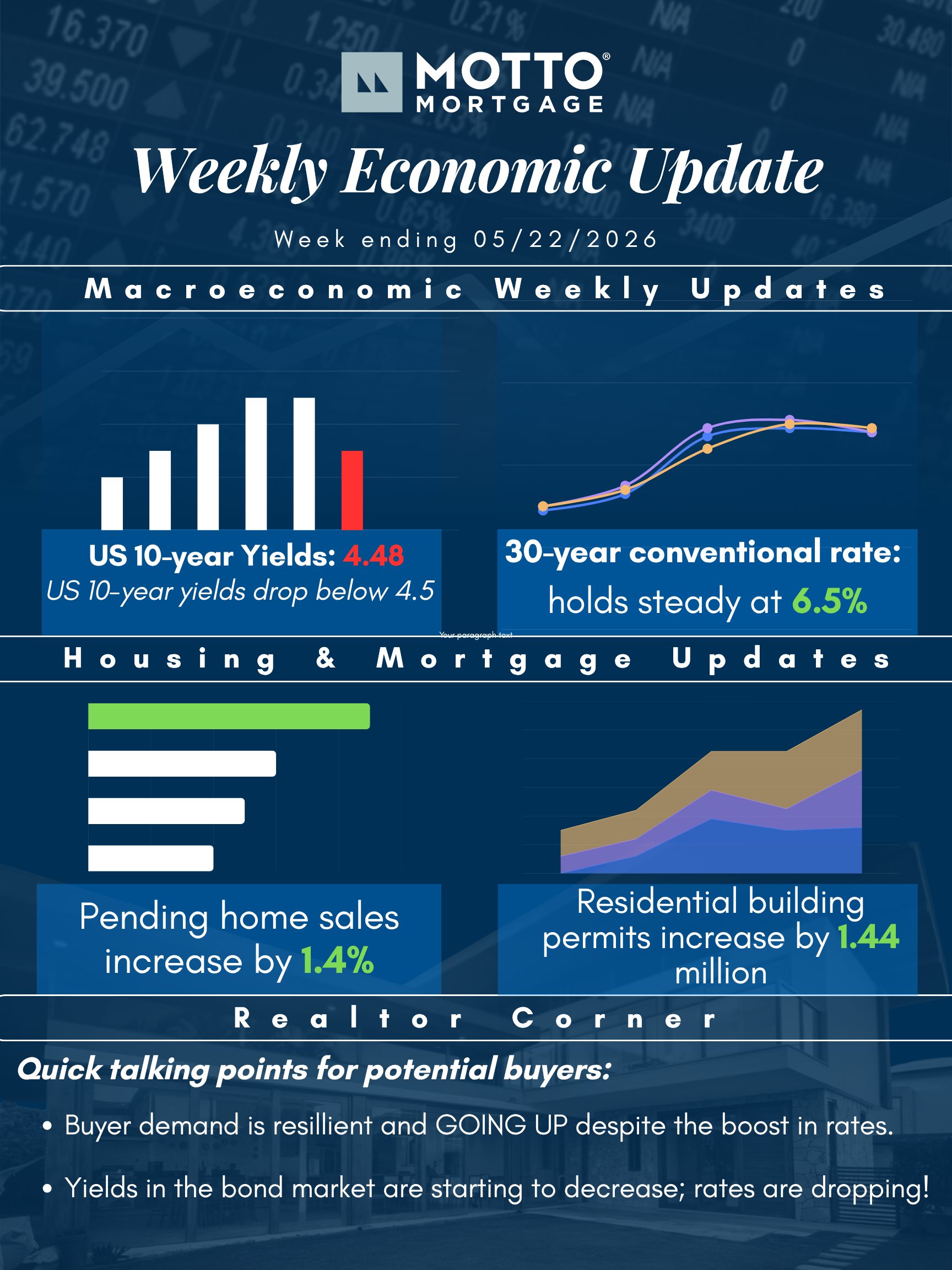
- US 10-Year Treasury Yields dropped below 4.5%, landing at 4.48
- The average 30-year conventional mortgage rate held steady at 6.5%
- Pending home sales increased by 1.4%
- Residential building permits rose to 1.44 million
Together, these indicators suggest that buyer confidence remains stronger than many analysts anticipated earlier this year.
What Falling Treasury Yields Could Mean for Mortgage Rates
Mortgage rates are heavily influenced by movements in the bond market, particularly the US 10-year Treasury yield.
This week, yields declined below 4.5%, which may signal potential stabilization — or even future easing — in mortgage rates if the trend continues.
For buyers who have been sitting on the sidelines waiting for the “perfect” rate environment, this may be an important reminder that market timing is never guaranteed.
Buyer Activity Is Increasing Despite Higher Rates
One of the biggest takeaways this week is that pending home sales increased even while rates remain elevated near 6.5%.
Many buyers are beginning to accept that today’s market conditions may represent the new normal, especially in high-demand areas like South Florida.
As a result, motivated buyers are choosing to:
- Purchase now instead of waiting indefinitely
- Refinance later if rates improve
- Secure homes before prices rise further
- Compete early while inventory remains manageable
New Construction Activity Continues to Grow
Residential building permits climbed to 1.44 million this week, signaling continued confidence among builders and developers.
In South Florida, new construction remains a major component of inventory growth, particularly in:
- Fort Lauderdale
- Miami-Dade
- Palm Beach County
- Southwest Florida expansion markets
More construction activity may eventually help improve inventory levels, although demand still continues to outpace supply in many neighborhoods.
What This Means for South Florida Buyers and Sellers
At Better Homes and Gardens Real Estate Florida First, we continue to see resilient demand from:
- Local buyers
- Relocating families
- Investors
- Cash purchasers
Today’s market rewards preparation, strategy, and timing more than speculation.
For sellers, properly priced homes are still attracting strong attention.
For buyers, waiting for dramatically lower rates could mean facing higher home prices and increased competition later.
Uncategorized •
May 18, 2026
Post #318
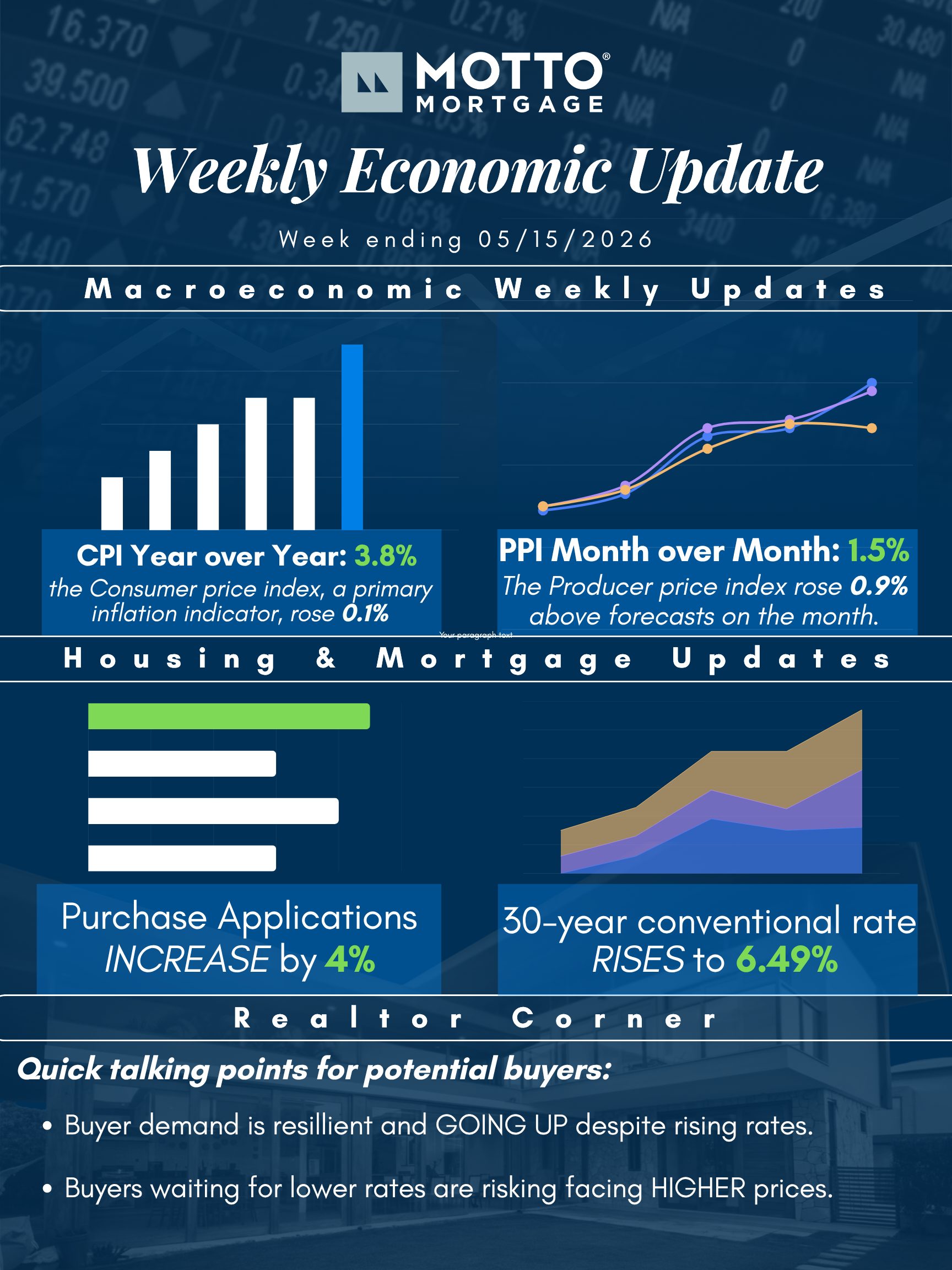
This week’s economic update from Motto Mortgage showed several important market shifts:
- CPI inflation came in at 3.8% year-over-year
- Producer prices rose 1.5% month-over-month
- Mortgage purchase applications increased by 4%
- The average 30-year conventional mortgage rate climbed to 6.49%
While rates continue to rise, buyer activity has not disappeared. In fact, mortgage applications increased this week, suggesting many buyers are adjusting to the current market rather than waiting indefinitely for lower rates.
What This Means for South Florida Buyers
Many buyers across Fort Lauderdale, Miami, and Palm Beach are realizing that waiting for significantly lower interest rates may not be realistic in the near future.
As inventory remains tight in many neighborhoods, buyers who continue waiting could face:
- Increased competition
- Higher home prices
- Fewer available homes
For some buyers, purchasing now and refinancing later may make more sense than delaying a move entirely.
What This Means for Sellers
Rising mortgage rates have slowed some activity nationally, but South Florida remains relatively resilient due to:
- Relocation demand
- Cash buyers
- Lifestyle migration
- Limited inventory
Well-priced homes in desirable neighborhoods are still attracting strong attention.